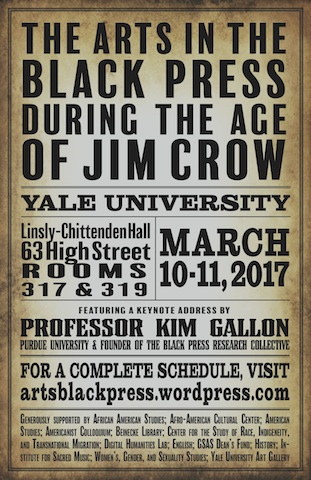
On March 10 and 11, scholars from various academic disciplines and institutions will gather at Yale University for an interdisciplinary conference titled “The Arts in the Black Press During the Age of Jim Crow.” The conference will explore coverage of the arts in African American newspapers and magazines between Reconstruction and the end of legalized Jim Crow segregation in the 1960s. Over the course of two days and 12 panel sessions, scholars will delve into the many ways in which the arts appeared in the black press during this era.
Some will focus on the artistic works themselves – cartoons and illustrations, short stories, and serialized fiction – which appeared in the pages of African American news outlets. Others will discuss artists who made their voices heard by writing for the press: for instance, saxophonist Cannonball Adderley’s columns for the New York Amsterdam News.
A few presenters will analyze more recent representations of the early-20th-century black press, such as those that appear within the novels Such Sweet Thunder (2003) and Jam on the Vine (2015). Still others will explore the richly varied arts criticism that emerged in black press outlets, from specialty publications like the Negro Music Journal to the São Paulo-based Clarim da Alvorada and the nationally circulated Chicago Defender. Keynote speaker Kim Gallon, assistant professor of history at Purdue University and founder of the Black Press Research Collective, will give an address titled “No Tears for Alden: The Black Press as an Archive of Black Performance and Performativity.”
The breadth of these topics gives a sense of how central the arts were to the black press during the Jim Crow era. In what might be described as a paradoxically generative outcome of racial segregation, the black press flourished in the United States during these years, providing rich, varied reporting on political and cultural happenings that mainstream press outlets distorted or ignored. Critics and reporters on the arts beat not only brought to light the creative output of black artists, but also investigated the role the arts played in the long struggle against oppression, as well as the economic and cultural impact of the arts on black communities and the United States as a whole.
Research on the history of the black press often focuses on its capacity to catalyze political organizing. For instance, in his excellent recent book, The Defender, Ethan Michaeli highlights that Chicago-based newspaper’s crucial role in encouraging mass movement during the Great Migration, critiquing institutional racism, and helping to elect politicians who might effect progress toward civil rights. Yet while political causes were certainly a vital component of the black press, they do not represent the totality of its cultural and historical significance. The conference hopes to highlight African Americans’ critical responses to the heterogeneous artistic scene of black America, which thrived even within an oppressive environment that constantly discounted and disrespected black lives.
Exploring these same press outlets’ coverage of the arts, as this conference does, complements and pushes the boundaries of a politics-focused narrative. The very existence of such extensive arts coverage within black newspapers shows how the African American artist living and working under Jim Crow was “no mere product of his socio-political predicament,” as Ralph Ellison puts it in his essay “The World and the Jug.”
Indeed, arts critics writing for the black press often declined to discuss politics overtly, as their primary goal was to document and record the artistic life of their communities. The Defender’s music critic, for instance, might devote an entire column to an African American soprano’s recital appearance at a church, detailing her dress, her repertoire, and how her voice had improved since past performances. Even such seemingly apolitical accounts, though, illuminate a revealing, politically weighted distinction between the work of African American critics and that of their white counterparts: Whereas mainstream publications tended to discuss African American performers as entertainers, spectacles, or conduits for a political message, critics writing in the black press took black artists seriously as artists. “On the level of the imagination,” Ellison writes in the same essay, black artists’ “ability to achieve freedom is limited only by their individual aspiration, insight, energy and will.”
At the same time, these newspapers showed how narrow the space between art and politics can be. Many conference presenters will discuss the political work of artists whose work appeared in the black press: a panel titled “Radical Artists” includes a discussion of cartoonist Ollie Harrington, for instance, who depicted African American veterans who were victims of police brutality during World War II. Thinking about work like Harrington’s reveals how the arts bolstered and amplified the messages that press outlets sought to convey via more straightforwardly political reporting.
With my co-organizer, Kristen Turner, I began planning this conference many months ago, before Trump was even named as the Republican nominee. We were motivated by the richness of this material and the possibility of bringing together a wide range of scholars who make use of it in their work. Perhaps inevitably, though, the themes of this conference seem freighted with additional meaning given the current political climate, namely Trump’s racist policy priorities and obsession with denigrating the press. In trying to understand how our work – as scholars, critics, and artists – might be useful in these times, I’ve turned again to Ralph Ellison, an exceptionally insightful theorist of the relationship between art, artists, audiences, and democracy.
In one of my favorite of his essays, “The Little Man at Chehaw Station,” Ellison identifies the imagined “little man” of the title as a “vernacular music critic” and the “American audience writ small,” a figure who continually listens to and comments upon what artists are doing. He describes the relationship between artist and listener as one that is collaborative, participatory, and ultimately democratic:
While that audience is eager to be transported, astounded, thrilled, it counters the artist’s manipulation of forms with an attitude of antagonistic cooperation; acting, for better or worse, as both collaborator and judge. Like a strange orchestra upon which a guest conductor would impose his artistic vision, it must be exhorted, persuaded – even wooed – as the price of its applause…By playing artfully upon the audience’s sense of experience and form, the artist seeks to shape its emotions and perceptions to his vision; while it, in turn, simultaneously cooperates and resists, says yes and says no in an it-takes-two-to-tango binary response to his effort.
It is our responses to art, no less than art itself, Ellison suggests, that make art matter in a democracy. This is a humbling proposition for listeners and critics: Our work doesn’t just respond to art, but helps to shape its meaning. As conference participants gather this week to explore the role of the arts in the black press during an era of American history shaped by segregation and racial hierarchy, I hope we can not only shed new light on work created by past generations of critics, but also think about the broader implications of writing and thinking about the arts in our perpetually imperfect democracy.
“The Arts in the Black Press During the Age of Jim Crow” takes place at Yale University, New Haven, CT, March 10-11; complete program and schedule here. Those interested in attending can email artsblackpress@gmail.com.
Lucy Caplan is the recipient of the 2016 Rubin Prize for Music Criticism. A magna cum laude graduate of Harvard College, she is currently a doctoral candidate in American Studies and African American Studies at Yale, where she is writing a dissertation on opera and African American culture in the early 20th century. Her essay “After November 8 – Music in Moments of Crisis” appeared on The Log Journal in November 2016. She can be reached at lucymcaplan@gmail.com.