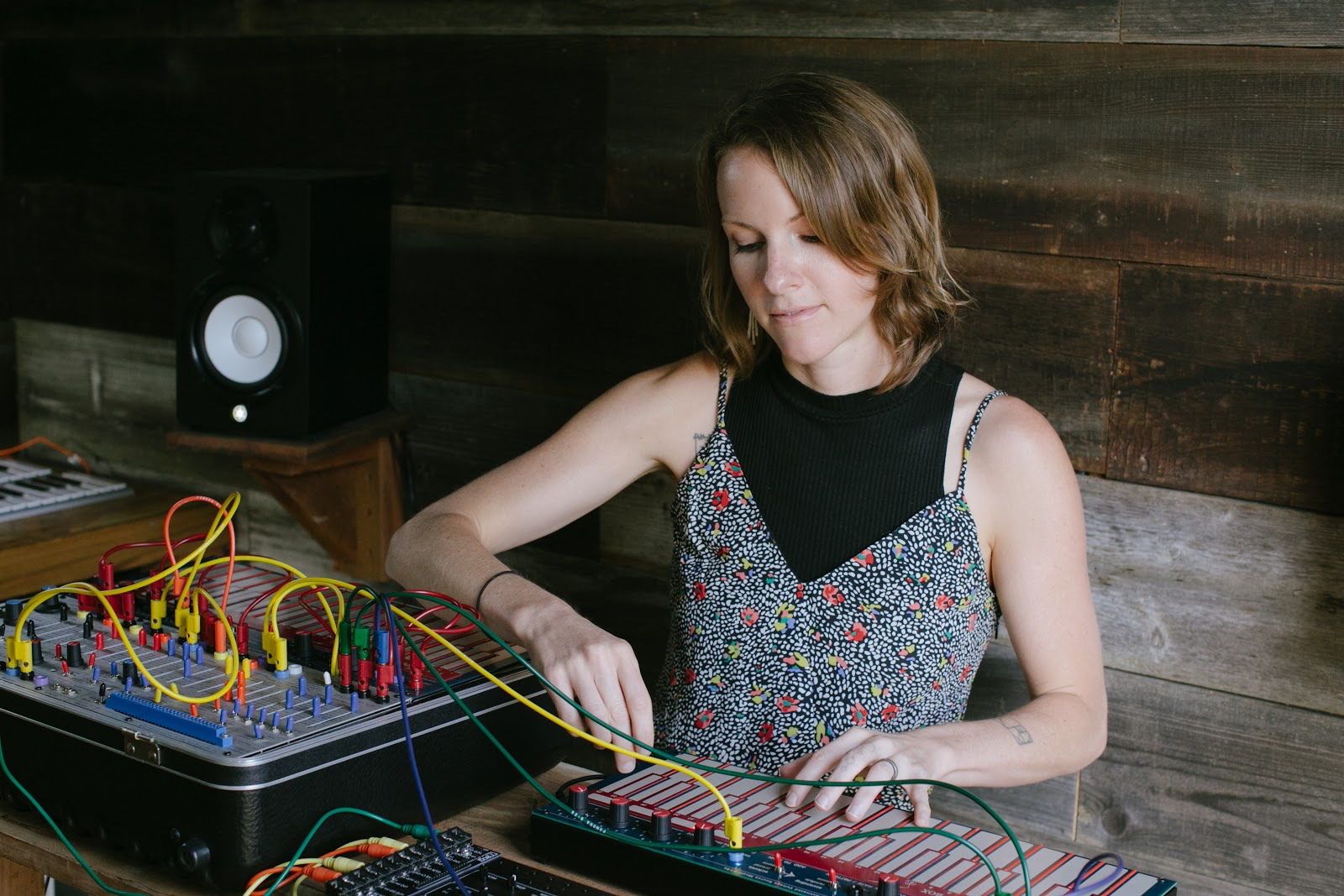
There’s no sonic precedent for the music of Kaitlyn Aurelia Smith. Genre labels like “ambient” and “New Age” begin to describe the lucid, transportive nature of the warm tones she produces, but fail to emphasize her focus on song structure and composition. A modern master of the modular synthesizer, Smith has traveled the globe with her Buchla Sound Easel, making the case for electronic music’s performative capacities by playing everything from all-day, droning sound baths to opening slots for Animal Collective. She’s written scores for everyone from comedian Reggie Watts to Google, who commissioned Smith to write music for their interactive homage The Hidden Worlds of the National Parks.
Last week Smith released her sixth LP, The Kid, a masterful melange of seemingly disparate sounds and visions shaped into a singular, focused narrative of self-actualization. While the name of each track telegraphs a distinct moment during the titular kid’s evolution, together they form an affirmation: “I Am a Thought/An Intention/A Kid/In the World/I Am Consumed/In the World, But Not of the World/I Am Learning/To Follow and Lead/ Until I Remember/Who I Am and Why I Am Where I Am/ I Am Curious, I Care/ I Will Make Room for You/ To Feel Your Best.”
The Log Journal checked in with Smith to learn how The Kid documents this development of creative consciousness through sound, what it takes to redefine fine arts patronage for experimental music, and how Smith’s synesthesia – a condition in which sounds generate colors in the mind – affects her performance for the better.
THE LOG JOURNAL: Are you a scientist?
KAITLYN AURELIA SMITH: [Laughs] That’s my favorite question I think I’ve ever been asked. I’m not a scientist, but I love science, and I love alchemy as well. Those are definitely two fields I’m interested in.
Turning trash into gold?
Exactly. Or transformation, the belief that you can make something out of anything, and persistence with that.
What better example than what you’ve done with the Buchla on this record, compared to its central focus on your other albums. The instrument is more of a template this time around, and so many other sounds are in the mix. What was the reasoning behind the sonics and the structure of the album. Why was arranging it in such a way important to you?
The main part of the theme of the album for me is about how, as we get older, we’re pulled away from our kid energy, from our sense of play, more surrounded by “I should do this” routine and structure. For me, the album is more about remembering your kid energy along the way.
“The hardest part of finding out your name is owning it and all that it contains.”
Oh no, you have the lyrics?! [laughs]
Photograph: Timothy Saccenti

Well, they matter, because you clearly spent some time on these lyrics. EARS had vocals too, but they sounded more textural and less pronounced. Why are they more deliberate this time around?
Well I knew that I wanted to tell a story, where with EARS it was more an environment journey. It was a different intention.
Those stated intentions in the lyrics are also in the album titles. How do you see yourself following that flow on this record? And what’s your creative input like, how does it feed back into that growth and reprocessing of your own sounds?
In the album, I was trying to sonically create development, through the beginning of the album sounding more sludgy, more dark, more awkward and stumbly, overly excited. As it goes on [the album gets] more sophisticated in its arrangements, more clear and more orchestral. It starts to feel lighter. I had a lot of fun doing that. I try and forget all my influences while I’m creating, but also know that they’re there in the subconscious. I listen to such a variety of music that I don’t have a formula [for] what will always inspire me. I have a lot of fun DJing, and have been able to do that more with an NTS show.
We should talk a little bit about your experiences with adventurous new-music programming in the city. Your work is especially interesting because it doesn’t fit into one category—while the avant and ambient communities have taken a liking to you, you also write orchestral scores, so you must have a couple of toes in that universe. What sort of opportunities exist in classical culture for such new sounds, be they electronic or just different?
It’s really fascinating, because the DIY movement has empowered a lot of musicians in so many ways, but there is one area that I see it not quite empowering musicians and artists yet, which I’d like to see more of. What I’m striving for myself is a cross-collaboration between those two worlds. Classic pop albums are that—these amazing arrangements from the classical world, but they aren’t reachable for a lot of people. It’d have to come from communities helping each other out, and organizations bringing these collaborations together. There is some of it in L.A., which is really rad—The Echo Society is a really amazing outlet for that.
There’s also a stigma of electronic music just not being that performative. But your modular synth work bridges that gap. So it puts you in a unique place to be that emissary.
I’ll take it! That sounds like fun. I’m also super curious about where the model of a patron can come back into play, like with brands. I’ve seen certain brands… Red Bull is a perfect example, of building this amazing foundation in the arts out of the money that they’ve made from the brand. I feel like it’ll be neat to see more of that happen.
Photograph: Aubrey Trinnaman
“In This World” has an almost Baroque opening. And there’s a woodwind run toward the end of the record, too. How did you source the non-Buchla stuff that we’re hearing, and how do you plan to keep yourself engaged with those instruments live?
Everything was recorded specifically for the record, no samples. Like on EARS, I really like to confuse what’s electronic or not. So in the beginning of the album, it’s probably electronic, and toward the end it’s definitely actual flute. I wrote parts for this ensemble called Stargaze. They played with Mica Levi for a while and some others. They were very nice. I sent them the parts, they recorded them and sent them back to me. Then I just tweaked the heck out of ’em. [Laughs]
They’ve done a lot of cross-disciplinary collaboration too, a lot of audio-visual stuff. It’s not getting any easier to get donors to take a chance on ambitious projects such as these, though. We’re still reliant on institutions. And classical music is still very much an “old money” game.
That’s why it would be so cool if brands got involved to make it all about collaboration— “What’s a good combo of people? Let’s see what they do.”
What happens at the end of this record? Do we arrive at a state of pure being? Where does the story wind up for you?
Well, it’s inspired by a cyclical life-cycle philosophy. I’m not saying that’s what I believe, but that’s what it’s inspired by. That’s why it ends with being all about grief. But the song’s bittersweet, because it’s also really positive. You’re going back to the reset of the cycle, returning to the source of your cycle. [Laughs] I’m trying to be really careful about the words that I use because it doesn’t come from a religious place at all.
Well, how deep is your love of Alan Watts? He’s cited in the press notes for this album, and as someone who dabbled in many religions during his life as a “journey, not destination” dude, his life’s work is a perfect parallel.
Yeah, that’s exactly it. And that’s what the kid energy is, too. Learning, or remembering, to be in love with the process, and not the landmark.
What’s next? What’s your ideal vision for seeing these songs live in a physical space?
Well, I wrote a whole treatment. It’s a whole 360-degree performance of this, with an ensemble, spatial visualizations and sound, dancers, and interactive aspects to make the audience a part of it. Performance-wise, I’m influenced by people like John Cage with the Rainforest performance [with David Tudor] , La Monte Young with Dream House.
Both major figures in the foundation of the Fluxus movement, working in New York traditions that we don’t necessarily see that much anymore.
Yeah.
How do your synesthesia and ASMR guide or hinder you in realizing your capabilities with multimedia performance? Does your extrasensory relationship to these sensations make you a trusted source for how these things talk to each other? Is it hard to stay focused?
No, it depends. Because I’m really sensitive, sometimes things will affect me too much, and I’ll get in a space where doesn’t feel good.
Can you let that guide you?
Yeah, exactly! What cue’s wrong, what texture’s wrong, and how do you fix it?
Kaitlyn Aurelia Smith performs at Good Room in Greenpoint Nov. 2 at 8pm; ticketfly.com