It’s only a slight exaggeration to say that if you’ve listened to much new music over the last 20 years or so, you’ve most likely already heard Stephanie Richards. A trumpeter, composer, improviser, and bandleader born in Canada, schooled in Los Angeles, and seasoned in New York City, Richards has spanned an almost unimaginable range of musical situations. Projects with Kanye West, David Byrne, and St. Vincent—check. Gigs with Henry Threadgill, Lawrence D. “Butch” Morris, Anthony Braxton, and John Zorn—check. Performances with Bang on a Can’s Asphalt Orchestra, the International Contemporary Ensemble, and the Kronos Quartet—check. Co-producer with Dave Douglas of the Festival of New Trumpet Music—check.
Phew.
Being that busy, it’s no wonder that Richards – now returned to the west coast as a professor at the University of California San Diego, is only now getting around to releasing her debut album. Fullmoon, issued May 18 on the Relative Pitch label, finds the trumpeter working with a longtime collaborator, veteran electronic improviser Dino J.A. Deane. Together, the two blur the boundaries of composition and improvisation, electronic and acoustic sound. Lars Gotrich, writing for NPR’s All Songs Considered, offers a concise, colorful summary: “Stephanie Richards’ trumpet sounds like deep space wrapped around your head, a flood in the endless void.”
Speaking by telephone from San Diego in advance of a performance with Deane and percussionist/synth maven Qasim Naqvi at National Sawdust on May 19, Richards talked about her long and winding path through New York’s new-music communities, the close connection she shared with Butch Morris, and how her new record came to be.
NATIONAL SAWDUST LOG: Your bio says you’re originally from Canada, but Canada is a big place. So tell me where you’re from, and how you came into this illustrious world of music.
STEPHANIE RICHARDS: I was born in a tiny town called Grand Prairie—which is exactly what it sounds like. [laughs] It’s in northern Alberta. I grew up in Calgary, Alberta, as a child. I started trumpet at the same time that a lot of kids do in, in junior high. And from there, my family relocated to Denver, Colorado. So I spent one year of high school there, and then I kind of just went off into music land—I went to Interlochen for my last year of high school, and then to college.
The question that comes to mind, especially for any trumpeter who spent even one year in an American high school, is at what point did you intersect with marching band?
I didn’t intersect, actually—which is so funny, because I played with Asphalt. I had zero interaction with marching band until I started playing with Asphalt, which is its own thing, but there’s such an athleticism to being choreographed and moving around outside of a concert hall.
It’s just amazing when I see what these kids are doing; I don’t know how these trumpet players do it, because the physical virtuosity that it takes to pull that off… I learned so much from playing with Asphalt. It’s definitely was a lot of… I mean it still is: every show we do, it’s like a major prep.
At what point did you hit New York City?
I hit New York after basically a long educational stint studying classical music. And I had a pivot point: I moved to L.A. first, and I started improvising and composing. I was at CalArts, and I also started doing more commercial work, playing backup with Kanye West. And I hit a moment where a lot of my friends were in New York, and a lot of people that I respected and admired. And I thought, you know, I just felt like I had to be there. I wanted to move to the city and essentially get my ass kicked—go there and just learn.
The Los Angeles improv scene is perennially overlooked. I’m wondering who you were interacting with there. Were you working in the scenes surrounding people like Vinny Golia?
Well, I was studying with Vinny at CalArts. I was studying with Vinny and with Charlie Haden. L.A. is an amazing city, it’s definitely not that I had anything against it, and in fact I love it even more now. But there was something pulling me to New York.
Photograph: Chris Weiss
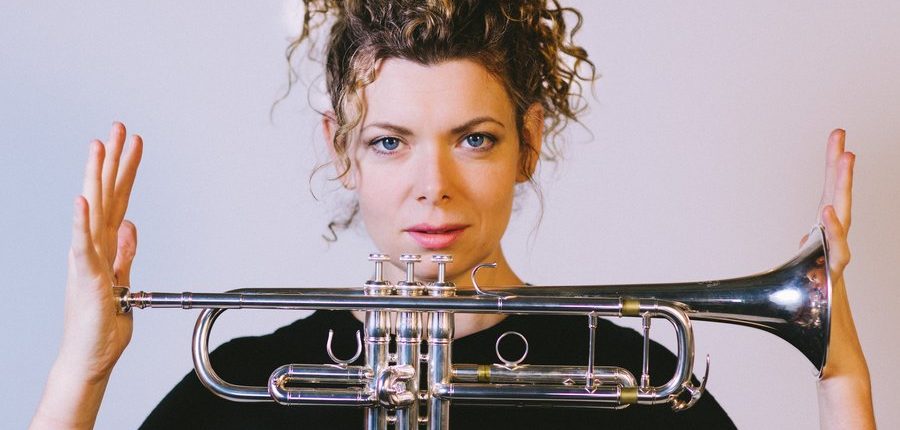
So you’ve come to New York to get your ass kicked. Who steps up? Who’s in line to kick your ass first?
Well, let’s see… Fred Hersch, actually. I had done a kind of workshop with him at Carnegie before I lived in New York. He was an important mentor to me. I was telling him I wanted to move to New York, and he really encouraged me to go for it—and also to know that it’s going to take four years before you even consider whether or not you’re quote-unquote making it. So it was with that little bit of encouragement that I moved out to the city, and pretty quickly hooked up with Butch Morris. Do you know Butch?
I never met Butch in more than an in-passing kind of way, but I had come up imprinting on the records that he was making with people like David Murray and Bobby Previte. That whole downtown scene was why I came to New York in the first place, and the first time I visited, I just realized this is where I was supposed to be. You feel it right away.
When you know you’re supposed to be in New York, it fills you up. It energizes you. I remember talking to Henry Threadgill about this. We were kind of talking about other places—I had just been offered a job in San Diego, actually – and I was asking Henry, should I take this job? And his answer summed everything up for me, too: it’s just that all the information’s in New York. I think he was coming from mostly a musical standpoint, but it’s all here in New York.
So Butch, he kind of took me under his wing, really early on when I moved to town.
When would this have been, roughly?
Probably like 2000. I started playing in his group – both his groups, actually – and there were several projects that were happening, so I met a lot of my current collaborators through Butch. The first time he heard me play and it was he, he pulled me aside, and the very first words he ever said to me were, “You’re not a trumpet player.” At first I was taken aback; I didn’t know how to respond. It took me a moment to realize he meant that as a real compliment.
I get a sense of what he probably was onto, but how do you interpret that?
Gosh, how do I put this into words? I took it as a compliment that my sonic approach wasn’t encumbered by the instrumental tendencies. Does that make sense? Maybe other trumpet players would play the trumpet in a certain way, and I was coming at it maybe with just a different sound in my mind—that I didn’t really play the trumpet, I was more just playing sounds.
I wondered about whether that was a matter of over-reliance on chops or athleticism. People think of trumpet, and I think automatically they don’t think of Miles Davis with a Harmon mute. They think of Maynard Ferguson and Allen Vizzutti.
Yes, exactly.
There’s a chopsmanship.
Yes. You nailed it.
And that’s exactly why I didn’t just listen to you playing Allen Vizzutti on YouTube just now. That didn’t just happen.
[Laughs] He’s amazing!
You play the hell out of it. It was really cool to hear.
It’s not supposed to have drum set with it, but I thought it sounded better that way.
So was it through Butch that you came into the orbit of Dave Douglas and the Festival of New Trumpet Music?
I’m sure tangentially there was something there, because through Butch I met a lot of people, like I said, that I play with now. He would kind of bring me around, he’d tell me what shows to go to, kind of like that old school New York thing where you just hang a lot with him.
Butch Morris was your Mr. Miyagi. Wow.
Butch was my Miyagi. I met Henry through Butch, because Butch just wanted him to hear me. And since Butch passed away, Henry has really become a close mentor for me, actually. And so there, there’s that, that’s style.
Their bullshit meters are pretty acutely tuned, so they obviously heard something real.
I respect working with musicians from that generation, from that time, because I think improvised music has a political importance that sometimes is harder to sense, especially if you experienced jazz and improvised music in school. To hang and play with these older cats that actually… you know, it’s life or death, it’s real. I feel like I’ve learned so much from being able to know Butch, and then also just to continue to be hanging with Henry and working with him.
This is actually unlocking something for me, because what I was having trouble drawing a bead on… and I mean this in the best possible way: I was having trouble drawing a bead on where to locate you in the continuum. I was hearing the new-music stuff, and I know about your work with Asphalt and Bang on a Can, and then I was hearing these improv things and watching your videos with Andrew Drury and Sylvie Courvoisier. I was asking myself where you position yourself on the spectrum. But if you’re coming up through Butch and Henry, then obviously the answer is: everywhere at once.
Sometimes it really does feel like that. When you’re in the new-music scene, the contemporary music scene, that’s its own thing. And being a jazz musician definitely, even from a technical standpoint, has its own demands. But honestly, I love to be able to work with experimental musicians, whichever genre you want to categorize it in. I feel so interested to be flexible in that way. I have this group with the drummer from Deerhoof, and it’s all like kind of indie-rock noise music, improvised noise music.
That’s Greg Saunier?
Yeah. To go from like something like that, and then working with Henry, or working with Asphalt or ICE or something: it’s a challenge, chops-wise. But I just feel so lucky. I really try not to put up those boundaries between the different scenes.
We seeing more and more of this. You’ve got people like Brian Chase playing in Yeah Yeah Yeahs, but also improvising and making solo drone recordings. And Greg Saunier made a really amazing record last year with Mary Halvorson and Ron Miles.
Oh my god, yes.
The boundaries don’t exist anymore for so many people.
Mm-hmm. I think this a thrilling time.
Were there specific musicians that you looked up to as influences, artists that you held up as examples of what you’d want to achieve? Did you have idols when you were younger?
Yes. It’s interesting… of course, there’s Miles, who just was so chameleonic. But also, I mean, I loved James Brown. I find myself still being really moved by people with this incredible stage presence and an ability to transform a room onstage. Ron Miles was actually a strong influence for me, growing up as a trumpet player. But then there’s this other side of things, like Joni Mitchell… I listened to a ton of Joni Mitchell growing up. I was obsessed with her for so long.
So then, how did you connect with Dave Douglas and FONT?
Taylor Ho Bynum was helping to curate the festival with Dave, and he had reached out to me. FONT was co-curating with the Vision Festival that year, and he asked me if I wanted to put on a show. And it blew me away. It was such an important thing for me to have a gig like that, a high profile gig, when I was fresh to New York—just to have that opportunity to be in the spotlight. It was a really meaningful performance for me. That was my first time in public playing the trumpet against the surface of water—which is kind of an obsession that’s been leading into this record.
Through Taylor I met Dave, and I remember after the concert I tried to let them know how much I appreciated the fact that they booked me, and I just asked if there anything I can do. And they just said, “Actually, we’re a volunteer-run organization… my god, we’d love your help.” [laughs] So I started co-curating with Dave, learning so much about the trumpet scene in New York, and about all the possible venues and these funding structures—things you don’t maybe think about from the performance side, but now as a presenter, you’re juggling different things. It’s been such a great learning experience, and also just a really important opportunity to try to find the players that are saying something that’s new, or weird, that are coming from diverse backgrounds.
Photograph: Ssirus W. Pakzad
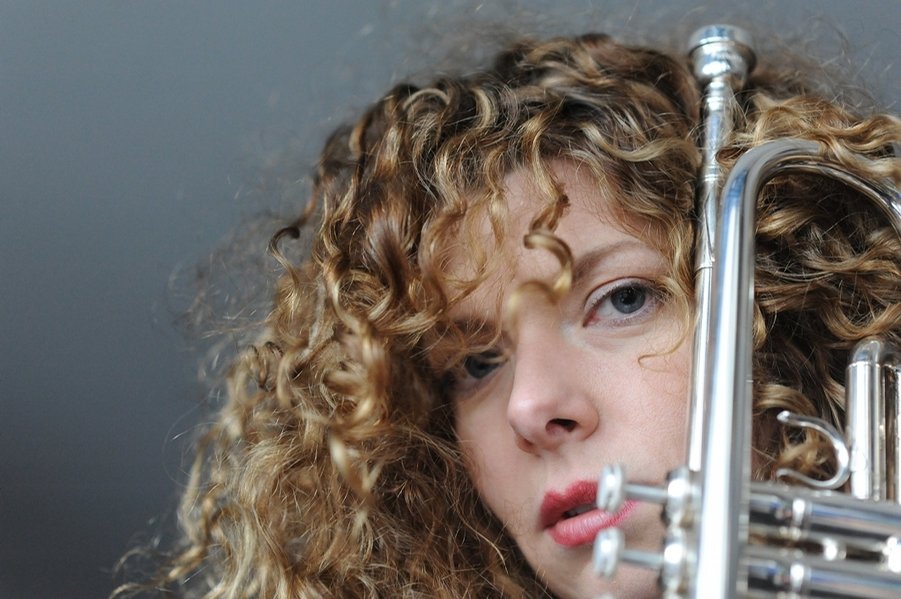
Let’s segue neatly into the record at hand. I’d guess it’s your connection with Butch Morris that led to your working with J.A. Deane?
Yes, it is. Absolutely. Dino came to work in New York years ago, and Butch said, you have to call Steph for this show. So that’s how I met Dino, and we became fast friends. And then when Butch passed away, I felt that it was important to start doing conductions myself.
Oh, interesting, I didn’t know that. I knew that Tyshawn Sorey had done some, but I hadn’t realized that anyone else was also pursuing that thread, which is so important.
It’s so important, and I just felt like I needed to do that, to learn. Dino had moved to Colorado, so I went to go visit him and study conduction with him. Butch never taught conduction to anyone except Dino—he was the only person. Dino worked with him, and had his own conduction practice. It was something that I wanted to do, but I didn’t feel right just picking up the baton; I wanted to work with Dino and hear from him about things that Butch had talked with him about, about this language that he created and the politics behind it. I started hanging with Dino, and we would just always play afterwards. So when I got this gig out in San Diego, I was teaching a course on conduction, and I thought, who better to bring in to talk about the practice? And that’s when we recorded this record.
Your San Diego position is current and ongoing, then.
It is, yes. The first three years I was, I would say, based in New York, so that was kind of insane. As of last March, I let go of my place in Lefferts Garden, and now I’m roommates with a neighbor down the street. So I can still come back to New York and have a place to stay, but I don’t come back as often. It’s important to be playing and hearing other people’s shows and to be around in New York, so I do what I can to sure to be around. But at the same time, it seems like you reach a certain point where it’s kind of illuminating to find out how the rest of the country lives, too.
Is the music on the record largely improvised, or is it heavily plotted out in advance, or is it somewhere in between?
Right in between. The composition that we had going into the studio was a structure that was essentially physical, meaning that I had physically placed instruments throughout the space in a particular way. And I had decided to choreograph myself through or between these instruments in a specific way.
Are those the “Resonant Bodies” pieces: “Gong,” “Piano,” “Snare,” and “Timpani”?
Yes, exactly. I had all these instruments set up essentially in a circle, and moving between them, that was the structure. And inside of that, Dino and I started improvising and working together, and because we played so much in the past, things fell into place very easily. And then from there, I sat with this session for a couple of years, and I listened to it so much. I memorized every single part of it, so I was able to start moving things around in my mind: what if this section had happened at the beginning? How would that sound?
It took me a long time, because I really wanted to sort of compose a piece of music using those materials in it that would be really concise and very musical. It took years. But I’m excited. I think this is a really interesting first record. It’s different than a lot of the stuff I do in live performance, so I’m really excited to share this kind of debut—I mean, in some ways I’ve been around for a long time, so it doesn’t feel like a big debut. But, you know, as something that I’m taking full responsibility for as a solo artistic statement, I’m really excited to share something that I think is quite different from what you might expect.
When you do this in live performance, do you work with a collaborator, or are you working completely alone?
Well, Dino will be there. And for this show, I brought in really great friend of mine, Qasim Naqvi, who’s a wonderful drummer and composer. I just thought, you know, why not? [laughs] I really thought that it would work with this particular project. It’ll be the three of us, and then also working in collaboration with a live projectionist. All the visuals are based off of this short animated film that was created for the record.
This is the “Gong” short?
Yes. The artist’s name is Aaron Vinton, but he’s going under the name Cossa for this project. This short film was created, and then from there I just asked him, could we use it? Besides just doing a screening of this film, could we actually break down these components and almost recompose them, just like what I did on the record, and can we have it happening in real time while people are experiencing the show? So that’s where that came from.
I was going to ask you about the video and how it came to be. Here’s a full blown new-music improv record, and yet you do actually have this clip to send around. We’ve come a long way since MTV, but is there some presumption now that you’re going to have some kind of a video component if you want to put a record out now and get some attention paid?
I do think that now, the way that we engage with music – especially online, because that’s where a lot of this is happening… with recorded music, there’s a visual component either way, whether it’s in your album artwork or… I think that video is a really helpful way that we can hear music.
The aesthetic of the clip ties in with the graphics on the album cover, and the whole thing has kind of a sort of pixilated Roy Lichtenstein feel.
The artist’s inspiration came from a Japanese artist from the ’60s [Tadanori Yokoo], actually, but it definitely does have that Lichtenstein feel. It was a big gamble to collaborate with an animator; I gave him full artistic license. I gave him the whole record and just said, can you create something with anything you find in this record that you find interesting? So he took half of one track and half of another track and put them together and created this short.
I feel like it’s a big risk, because the video influences how we hear. It’s going to have a massive influence on how people are going to perceive this project, and I knew that going into it. But I also have so much trust, because Aaron Vinton doesn’t do very many animated projects; he’s actually mostly known as a graphic designer. But I met him in school and I love his work so much. It’s like any collaboration, right? You’re putting your trust in another artist, to see what they’ll come up with. And as soon as he sent it to me, I was just like, this is total magic.
Stephanie Richards performs at National Sawdust on May 19 at 10pm; nationalsawdust.org