The journey alto saxophonist Alan Braufman has traveled has been epic, unconventional and memoir-worthy.
Brooklyn-born and Long Island-raised, Braufman spent the better part of the 1960s as a teenage jazz head, club hopping legendary New York City haunts like Slug’s and the Village Gate to see heroes like Miles Davis, Charles Mingus, Thelonious Monk, Art Blakey and the Jazz Messengers, Rahsaan Roland Kirk, and Roy Haynes. From there, the fledgling saxist attended music school in Boston, only to find himself helping plant the seeds of what would become a crucial, yet way underground, avant-garde jazz movement in downtown New York City alongside the likes of tenor saxophonist David S. Ware and pianist Cooper-Moore (then known as Gene Ashton).
The loft-jazz scene that was the artistic and countercultural rage in SoHo during the ’70s is a well-documented one where creatives flocked and the origins of DIY can be traced at famed destinations like Studio Rivbea (saxophonist Sam Rivers’s Bond Street building) and Ali’s Alley (drummer Rashied Ali’s Greene Street music den). 501 Canal Street, the broken-down building where Braufman and his peers lived in squalor and put on performances in the storefront, was overlooked by comparison. Now it’s gaining in notoriety due to a long overdue reissue of a vital, largely unheard recording by Braufman, furthering his legacy while adding another layer to his improbable path.
Originally captured on tape at 501 Canal in 1974 and released on the India Navigation label, Valley of Search has achieved cult status over the last four decades—a hidden treasure of the spiritual-jazz realm that mines similar sonic planes as Pharoah Sanders and John Coltrane, and Cooper-Moore’s first appearance on record. Having long fetched premium prices on Discogs and eBay, Valley of Search now has been remastered and reissued through the tireless efforts of Braufman’s nephew Nabil Ayers, the U.S. label manager for storied U.K. imprint 4AD, and founder of indie label The Control Group. Ayers spent the bulk of his childhood at 501 Canal, and his undying love for the record inspired his quest to make it readily available.
After a decade spent at 501 Canal, during which Braufman played in groups led by pianist Carla Bley and drummer William Hooker, his sound and vision underwent a reinvention of sorts. Braufman not only enjoyed a stint touring with the Psychedelic Furs, but also ultimately traded in the ecstatic free-improvisation of Valley of Search for the slicker, synthesizer-based, pop-leaning jazz of 1988’s Lost In Asia, released under a new name: Alan Michael. By the mid-’90s, Braufman would leave New York City for Salt Lake City, where the 67-year-old still resides and is a staple of the live scene.
Now, with the reissue of Valley of Search, Braufman is returning to New York and his free-jazz roots, adding yet another twist to his intriguing story. Along with his longtime friend, 501 Canal roommate and musical partner Cooper-Moore, he has enlisted tenor saxophonist James Brandon Lewis, bassist Ken Filiano, and drummer Andrew Drury, and will perform Valley of Search in its entirety on August 3 at National Sawdust—the first time they’ve played these tunes in 40 years.
Alan Braufman (left) and Cooper-Moore in 1975.
Photograph: Bob Cummins
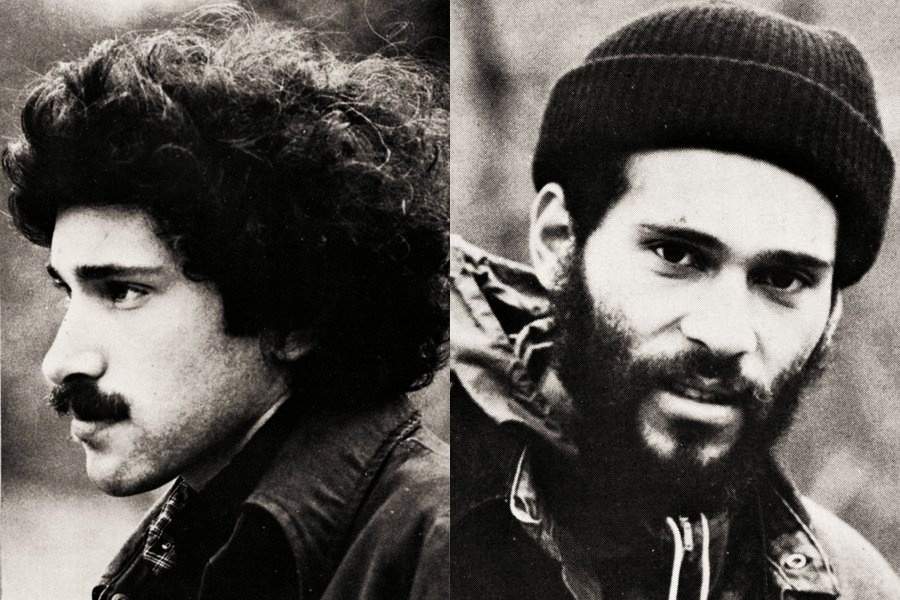
National Sawdust Log recently spoke with Braufman, Cooper-Moore, and Ayers about the scene at 501 Canal Street, the story behind Valley of Search, its reissue and more.
NATIONAL SAWDUST LOG: What do you recall about your nephew Nabil, who spearheaded the reissue of Valley of Search, being at 501 Canal?
ALAN BRAUFMAN: I guess I was a father figure; it felt like he was my first son. When I moved down to Canal Street, Nabil was one [laughs]. That was ‘73 so I was there for ten years. He was there quite a bit from an age he can remember from. 501 Canal Street was kind of an interesting space there.
So you were at 501 Canal for a decade?
BRAUFMAN: I was there 10 years, but as far as it being a vital music place, it was really just three. When we moved in ’73 from Boston, Cooper-Moore found the building. He moved in on the first floor, I shared the second floor with David [S. Ware], and we did the concerts downstairs. But three years after that, around ’76, Cooper-Moore had moved back to Virginia for a while and David moved out. Then Tom Bruno, the drummer, moved into the performance space, so there was no more performances there. As far as doing the concerts and having music there, that was ’73 to ’76, the good years there.
What do you remember about New York City back then?
BRAUFMAN: New York had a lot of problems. It was more dangerous, it was a dirtier city, and the air was worse. But at the same time, you didn’t have to be a corporate lawyer to live there. There was also much more excitement and vitality in the city, as far as art was concerned. It’s safer today and cleaner, but I’d take the old days any day.
COOPER-MOORE: The neighborhood around 501 Canal between Renwick and Hudson during the work week was cars and commercial trucks. It was at the Holland Tunnel entrance to New Jersey. New York City was bankrupt. Air pollution was making people sick. But Friday night to Monday morning, it felt like we owned the city. There were no cars or trucks. None! When we lived down on Canal it was in the First Precinct, the safest precinct in NYC. No one at 501 Canal locked their doors. A number of times strangers walked in off the street and came into our apartment. The ’70s in the city was hard and could be very difficult. But for us, being in New York was an opportunity.
What about 501 Canal?
COOPER-MOORE: 501 Canal was a community, a community of musicians. None of us had money. Sharing was common. The thing that sticks out in my memory of those times, in that space, is the sound of the piano, the drums, saxophones, the bass, singing, and nobody is complaining. Music was being played at all hours, no complaints.
NABIL AYERS: That was such a weird, empty, desolate neighborhood. It wasn’t a bad neighborhood; it was just off the grid. I just remember Alan playing saxophone constantly. I would say he would practice maybe four or five, six hours a day. He was really disciplined and he would go to Aikido classes a lot at this place New York Aikikai, which was on maybe 18th Street. I would go with them everywhere when I was in New York. I would sit around while he played saxophone, we’d go play Frisbee, then he’d go to Aikido, then come back and play saxophone. We would eat at Souen, which opened around the same time as all of this, actually. Souen was sort of a big part of it in my head. Souen is on Prince and Sixth Avenue. It’s one of the first famous macrobiotic restaurants, a very minimal Japanese brown rice and vegetable place.
I grew up with my mom. Sometimes we lived in Amherst. We were there for four years while she went to school, we were in Boston for a couple years, and then we were in New York, but we never lived at 501 Canal. We lived nearby in the Village. But that whole time, even when we lived in Amherst, I was probably in New York four or five months out of the year, or we would just come here for a whole summer. I would come up, take the bus, and hang out for a month. It definitely felt like I lived there, even though I didn’t, technically.
Nabil, can you recall anything about the other musicians who lived at 501 Canal?
AYERS: More Tom [Bruno] than anyone, just because I wanted to play drums so bad and that’s where the drums were, downstairs in Tom’s place.
Alan, at what point did you realize that Valley of Search had morphed into a record collector’s cult classic?
BRAUFMAN: It’s funny, I had no idea until Nabil told me that he had seen original copies unopened that went for $180 on eBay. I said, “I didn’t know! Okay!” It was nice to hear. Of course, I wish it got more notoriety when it was released, but what can you do?
What do you think it is about Valley of Search that resonates with listeners?
BRAUFMAN: I would think that it has to be just that it was an honest record. We just did exactly what we wanted to do. We had no constraints whatsoever. Bob Cummins, the founder of India Navigation, set up microphones in the building’s storefront. We’d been doing that music a lot, so we didn’t have to have much preparation for the recording session.
All the titles have a spiritual and uplifting kind of vibe. Was that intentional because you were into Pharoah Sanders and Coltrane at that time?
BRAUFMAN: Absolutely. When [Coltrane’s] A Love Supreme came out, I was like 12. We were kids listening to that [laughs]. We also listened to the Beatles. It really affected me, as it did so many other people spiritually—not in a sectarian sense like in religion, but just in the general sense that there is something behind the music spiritually, and trying to express that, and I was affected by what Pharaoh was doing at the time. I think a lot of people were. I still am! I really haven’t changed that much in that respect at all [laughs].
You moved from Boston, and there was certainly a great creative music scene happening there with Michael Cosmic, Phill Musra, and others.
BRAUFMAN: Yeah, they eventually moved down and got a place across the street from us on Canal. We were on Hudson and Canal and they were Hudson and Greenwich, just across the street. We used to hang out a lot together.
David S. Ware also came down from Boston with you.
BRAUFMAN: I remember when I was in Boston, like my first year, David was already a legend. But he wasn’t there when I got there—he had taken a year off. It was maybe six months after I got to Boston that David returned for the next semester and it was the legendary David Ware. The first time I heard him I said, “Wow! I see what people are talking about.”
Then you shared a floor at 501 Canal with Ware.
BRAUFMAN: Living with David for three years was like saxophone central. He had the front of the loft and I had the back, and we’d just be practicing all day. When we’d get tired of two horns on the floor, I’d just move down to the storefront. Just hearing David practicing all the time was influential.
That must have been a crazy time living at 501 Canal with David S. Ware, Cooper-Moore…
BRAUFMAN: …and Jimmy Hopps, the great drummer who played a lot with Rahsaan, Pharoah, and Charles Tolliver’s Music, Inc, band. I forget how long he stayed. He took the fifth floor, and as bad a shape all the floors were, the fifth floor would have been condemned. It was unlivable.
What were the living conditions like?
BRAUFMAN: I was 22 when I moved there, but I wouldn’t want to live in those conditions today. When you’re young you can take more. We had no central heating, so if you wanted to heat the place, you’d have electric heaters in each room. They used a ton of electricity and they were also fire hazards to leave on too long, so at night everyone would turn the heaters off and get under a ton of blankets. Even though we worried about the electric bill, it never came. Con Edison never came around. It was an interesting place: free long distance calls, free electricity, and $140 a month for rent.
Nabil, how did the Valley of Search reissue come about?
AYERS: Alan is in Salt Lake now, but he comes to New York like once a year and he always plays with Cooper-Moore. It was last summer when they did something at a jazz school in East Harlem. They played this show there and it went really great. Then at the end of last year, I did a blog post for KEXP in Seattle, which is a great alternative indie station. I was writing about favorite shows, records and things that happened over the year—just like quick blurbs. When I was thinking about it, I was like, “That concert is an interesting one. I should write about that.” So I just mentioned it and shared it on Facebook. I was really surprised how many people were like “Whoa. You saw this show?! I didn’t even know about it! Oh, Cooper-Moore! Oh, Valley of Search!”
Then I decided to tool around online. I realized that there are some really bad YouTube rips of the album that sound terrible, but that’s cool that they have some plays and people are interested in it and it’s on Discogs selling for like $58 average. There were just these things that kept making me think, “Wouldn’t it be great if people could hear a really good version of this? Wouldn’t that be cool?”
Like a labor of love project?
AYERS: Yeah, exactly. So I talked to Alan about the idea. I didn’t think it would be that hard to do, and he was totally into it. No one had a master and there’s no chance of finding the master, so that was the only drag [laughs]. So we used the LP that has only been played a few times and was in great shape. I brought the record out to Joe Lambert, who is a really great mastering guy in Jersey City, and he mastered it from the LP. I think it sounds better than the original. He went and did it from a turntable and took away the little pops and scratches, and made the piano a little bit louder, which was Alan’s only complaint about the original thing. It was seriously just this KEXP blog post that got a couple of people talking about it, and me realizing that it was something we should do.
Alan, with the reissue, did you have to go back and revisit Valley of Search? How involved were you?
Actually, I really haven’t re-listened to it yet. It’s fresh in my mind; I know the album. Nabil kept me in the loop, because one of the things on the original recording was that the piano was too distant. We were able to go out and grab that and bring it more to the forefront with the technology they have now. It’s not as out there as I would have liked, but it’s a lot better.
Cooper-Moore, have you gone back to Valley of Search? What are your thoughts on it and your playing on it after all these years?
COOPER-MOORE: The reissue of Valley of Search has prompted me to revisit a time in my life of tremendous growth as a musician. This growth, I believe, stemmed from living with a group of acutely focused artist who felt that they were on a path together: David S. Ware, Tom Bruno, Philip Polumbo, Alan Braufman, Paula Ashton, Lauren and Jonathan Ashton, Ellen Christi, Chris Amberger, Cooper-Moore, Jimmy Hopps.
Alan, do you have copies of the original release?
BRAUFMAN: I have two copies that are both unopened. I’m not going to open them. They are the two originals back when it was first released. It’s like having an old pack of baseball cards—you don’t want to open them [laughs].
After your time at 501 Canal wound down, you went on to play in Carla Bley’s groups and with William Hooker.
BRAUFMAN: I was playing with William on and off, and I toured with Carla from late 1977 to 1981, which was a lot of fun, a fun band. I got to play with some of my heroes like Roswell Rudd. In the original band, Roswell was playing trombone and Andrew Cyrille was on drums, and of course Carla, and Mike Mantler playing trumpet.
When did you actually leave New York?
BRAUFMAN: I didn’t leave New York until the early- to mid-’90s.
During that period, David S. Ware and William Hooker were still doing their thing. Were you still deep in the scene?
BRAUFMAN: Not as much, because I sort of went in a different direction with my music. It’s a funny story, because it’s connected to my name change: now I’m Alan Michael. I did an album called Lost In Asia that I’m really proud of and that I like a lot. I recorded it myself, financed it myself, and everything. I was sending it to different companies trying to see if I can get it released. I’d invariably send it somebody, then call up the company and talk to the receptionist. I would probably not talk clearly enough and they would take five minutes to get my name right. I’d have to spell it three times, and I got sick of that. So the next company I was sending it to was Passport Records, and I was just going to drop “Braufman.” My middle name is Michael, and I was just going to go with that. They actually liked [the record] and released it, and it was released under Alan Michael. So I was like. “I guess that’s who I am now.”
You said you went into a different musical direction. Did you see that as a reinvention?
BRAUFMAN: I really thought that music was going to go this way and I think it would have been a really interesting way for it to go but it never did. In the early ’80s I was playing with one of the earliest synth bands, named Our Daughter’s Wedding. Then I toured shortly with the Psychedelic Furs because Gary Windo, the tenor player in Carla Bley’s band, was doing that gig. There’s a funny story where Gary called me up one day. This was in 1982 and I had never heard of the Furs, and he said, “Hey, do you want to tour with Psychedelic Furs?” And I was like “I don’t know. Who are they?” Gary said “They are this band and I’m doing a tour of North America right now, and there’s some gigs I can’t make. Can you do ’em?” I said “Yeah, sure. When’s the tour?” And he said “Oh, they’ll pick you up tonight at 8 o’clock.”
So at 8 o’clock there’s a big tour bus in front of Canal Street. I wound up doing the Canadian gigs because Gary had a visa problem, and if he went to Canada he was afraid he wouldn’t get back in.
That’s crazy that you went from the free-jazz loft scene to touring with the Psychedelic Furs.
BRAUFMAN: [Laughs] What I learned from that was as far as the energy that I could put in, it didn’t feel any different to me than playing free jazz. It was energetic and emotional, and that’s really the way I went. I was very influenced by writing simpler melodies that were easily singable. It certainly wasn’t smooth jazz; I would be hesitant having called it that. It’s more like a blend between the spirit and intensity of avant-garde jazz with synth-pop—that’s what I was doing on that album, Lost In Asia. I’d say that now it’s gone along that direction still. I really think that my free-jazz experiences changed the way I play when I’m not playing per se free jazz. I can get them to that intensity that that taught me.
You have two Valley of Search release events, including one at National Sawdust. How do you feel about coming back to play New York?
BRAUFMAN: I’ve been coming back once a year, doing some concerts with Cooper-Moore. A couple of years ago I did the Vision Festival with his band and things he’s been doing.
Do you have to go back and relearn anything from Valley of Search?
BRAUFMAN: Oh, no, I don’t—I still remember it. But for the first time I’ll have to write out charts [laughs], because when we lived [at 501 Canal] we would just play and rehearse, and nothing ever got written out. But now I’ll put it down.
Do you have any regrets about moving out of New York so many years ago?
BRAUFMAN: I knew I would have regrets when I moved, but I see no point in reliving them, thinking about them. It is what it is. I’m glad I’m still excited about music, still playing music, still practicing a lot, and have an opportunity to go back and play and do the stuff here and see where it goes.
Alan Braufman performs selections from Valley of Search at WNYC’s Greeene Space on August 1 at 6pm; thegreenespace.org. He and his band, including Cooper-Moore, will play the entire album at National Sawdust on August 3 at 8pm; nationalsawdust.org.
Brad Cohan is a music journalist based in New York City. His work has appeared in the Observer, the Village Voice,Time Out New York, Vice, and Noisey.