It is impossible for an experimental opera to be unsuccessful, at least insofar as the goal of an experimental opera is to figure out whether something works or not. So in that sense, Experiments in Opera presented four wildly successful modular-synthesizer operas on Nov. 2 and 3 at The Flea Theater. As compelling dramatic combinations of narrative and music, however, the results (reviewed on Nov. 3) were decidedly more mixed.
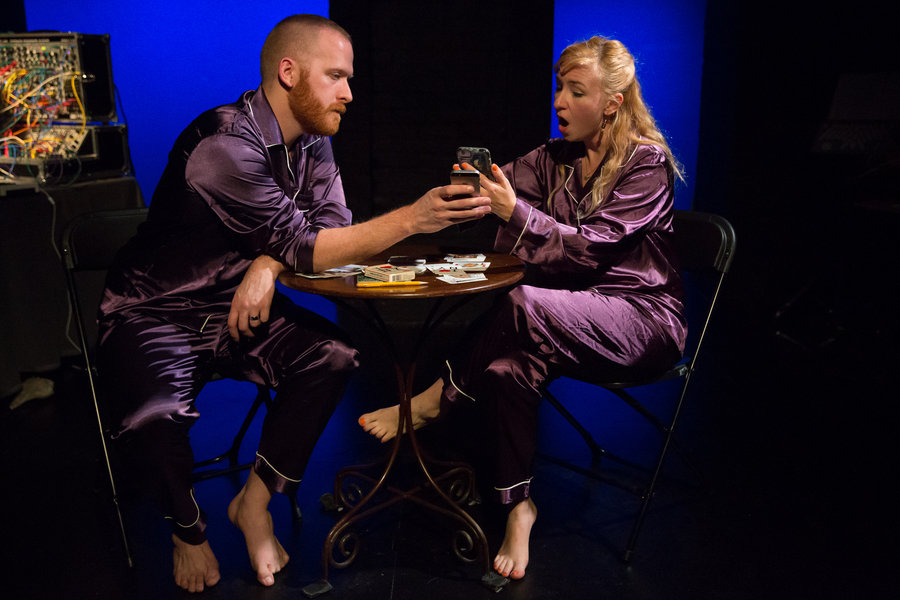
Perhaps the most intriguing approach was Candy Corn by Jason Cady, with Alize Rozsnyai and Calder Craig playing a young couple battling contemporary malaise while grappling with the suicide of a loved one. The singers’ lines were forced into rigid fragments over a relentless foursquare beat, making their conversations sound stilted and inhuman.
In the final scene, the work folded over on itself: As Craig’s character pondered a synthetic immortality, in which a person could live on after death by having an algorithm use their memories and social media posts to simulate their mind, the opera itself started to seem like an exercise in just such a simulation. Both characters were dancing disjointedly with moves that were already uncool in middle school (including a deconstructed macarena), their motions disconnected from their dialogue and affect. The impression was of bodies being controlled by an outside force, of a machine frantically shuffling through imagined lives in a despondent search for some ineffable human quality missing from its computational heart.
The rigid pulse of Cady’s music within each scene gave way to freer material in the pauses between them. After the second scene, Cady, who was playing the synths himself, let loose with a wild and winding solo, a distressed wail from an animal trapped in a snare beyond its comprehension. But the conclusion was a let-down: Cady added a whispery rhythmic fadeout at the end of the last scene, undercutting a line that would have landed with a punch and giving it the force of a wet noodle instead.
Calder Craig (L) and Alize Rozsnyai in Jason Cady’s ‘Candy Corn’ at The Flea Theater
Photograph: Reuben Radding
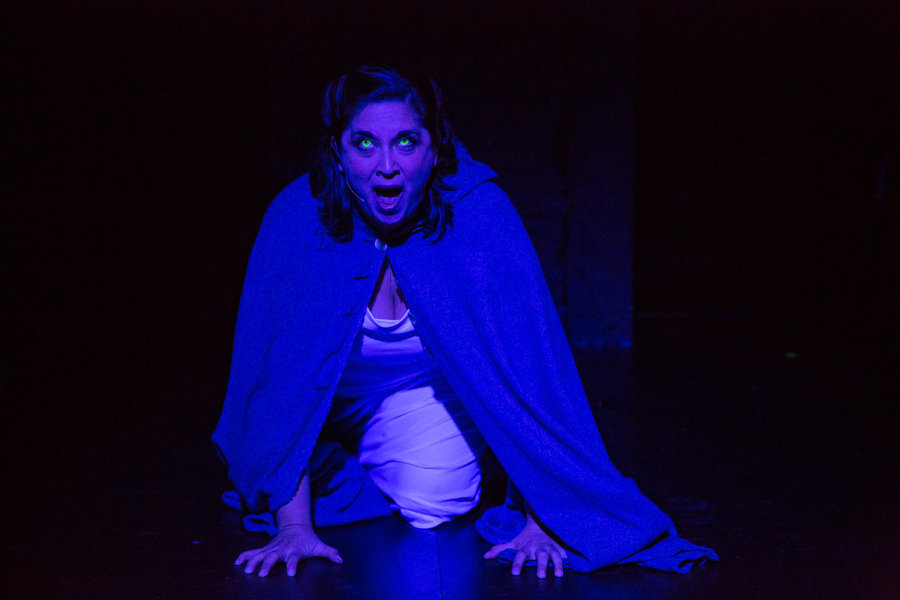
Kamala Sankaram took a much less rhythmic approach to deploying the synthesizer in The Wife, her chilling werewolf story with a twist. Instead of laying down imitations of regular drumbeats, Sankaram built up dense, buzzing textures that blended seamlessly with the accordion that rounded out her forces, rich and earthy as peat bog moss. (Red Wierenga played both accordion and synths; Sankaram sang the vocal role.)
The central twist worked well in this stripped-down production with minimal costumes, but a more fully realized staging might spoil it with the character’s very first entrance. Conversely, the shallow, confined space of The Flea’s downstairs theatre was too small for Sankaram’s powerful voice. The intensity of her vocal climaxes was necessary to convey the intensity of her character’s duress, but with nowhere for that energy to dissipate, the results were sometimes physically painful.
A similar problem occurred in Virginia and the Time Machine – words by Monique Truong and music by Joan La Barbara – albeit without the clear emotional arc. Julia Meadows played a young Virginia Woolf, conjured as a memory by the older Woolf (played by La Barbara) to escape the stress of being a pacifist in WWII England. The synth (Miguel Frasconi) played the role of the titular time machine, representing periodic intrusions of the WWII present into the 1890s past (which was accompanied by Bryan Hayslett’s cello), but the effect was muddled.
It wasn’t clear whether these intrusions represented 1940s Virginia remembering her current predicament or 1890s Virginia receiving a ghastly premonition of things to come. Truong’s libretto offered little help, repeating similar (or even identical) passages of text in a move that called to mind Gertrude Stein’s gnomic aphorisms more than Woolf’s own richly developmental prose.
Kamala Sankaram in ‘The Wife’ at the Flea Theater
Photograph: Reuben Radding
Indeed, the most viscerally gripping moments in Time Machine had no words at all. A cryptic prelude offered the older Virginia carefully retrieving books from a heap of rubble while the younger Virginia mirrored her actions a few feet behind her over a seething mass of sound. Later, the younger Virginia ran across the stage to escape the critics of her pacifism and bumped into the modular synth setups from the other operas. She blanched, recoiling from the impassive arrays of wires and blinking lights, bewildered by their opaque technological edifices. These were powerful sequences that could have anchored a captivating story, but the rest of the work had little to offer.
Argentine-American composer Andrew Raffo Dewar offered even less in Volver. Dramatically backlit between two columns, Roland Burks sang plaintive wordless vocalises and uttered harsh whirrs and consonant clusters, which were all woven deftly into the background of discordant bells from Dewar’s synth, but the resulting atmospheric tapestry lacked any sense of tension or forward momentum. The text for the piece came in the form of clips from oral histories collected by Christine Valenciana in the 1970s, describing the U.S.’s forcible deportation of Mexican Americans (including U.S. citizens) in the 1930s.
The speakers describe appalling things, but their tone has the neutral distance of 40 intervening years, and their words were sometimes lost in the churn of Dewar’s soundscapes. Three different stories were cut up and interspersed, making it difficult to follow the full details of any one account. Dewar’s music offered little more than distraction, a barrier to feeling the weight of this history and grappling with its intensified reprise in the present. If Dewar was trying to make a political point, it was lost amidst the gurgles and croons. His work was a successful experiment, but only in showing what not to do.
Brin Solomon writes words and music in several genres and is doing their best to queer all of them. Solomon majored in composition at Yale University before earning their MFA in Musical Theatre Writing at NYU/Tisch. Their full-length musical Window Full of Moths has been hailed for its “extraordinary songs” that “add magic to otherwise ordinary lives”, and their latest one-act, Have You Tried Not Being A Monster, has been described as “agitprop for Julia Serrano.” Their writing has appeared in VAN, New Classic LA, and National Sawdust Log, and they recently won runner-up at the 2018 Rubin Institute for Music Criticism.
Classical music coverage on National Sawdust Log is supported in part by a grant from the Rubin Institute for Music Criticism, the San Francisco Conservatory of Music, and the Ann and Gordon Getty Foundation. The Log makes all editorial decisions.