Sometimes, I get the urge to walk forever. The sidewalk stretches out in front of me and I imagine my feet stepping one after the other until I slip between the cracks in the world and disappear. I don’t know if percussionist Steven Schick feels similar yearnings, but he did once walk, over the course of six weeks in 2006, from the U.S./Mexico border to San Francisco, a journey of some 700 miles.
Schick wrote about the experience, and the resulting travelogue caught the eye of august composer George Lewis, who has now turned it into Soundlines: A Dreaming Track, an expansive new work for speaking percussion soloist and chamber ensemble. That piece was presented, along with Lewis’s P. Multitudinis, this past weekend at NYU’s Skirball Center, performed by the International Contemporary Ensemble and participants in the Ensemble Evolution program at Banff Centre for Arts and Creativity (including returning alums).
As envisioned by the composer, Schick himself took the solo part, declaiming fragments of his text in a heightened style that sometimes bordered on sing-song while delivering virtuosic performances on an impressive array of instruments that included xylophone, shekere, tambourine, and harmonica. The text fragments included both linear narrations of events and abstract musings that often drew on memories of growing up on a farm. Shorn of a continuous narrative framework, these fragments blurred together into a dreamy, meditative wash, like a mind free-associating with nothing else to keep it occupied.
The piece includes a near-constant use of live electronics, incorporating field recordings from Schick’s journey with echoes of the acoustic players, sometimes verbatim, sometimes heavily distorted. These echoes often pile up into hazy soundscapes, but just as often they return crystal clear much later in the piece, an unexpected goad, an intrusive thought that won’t stay forgotten.
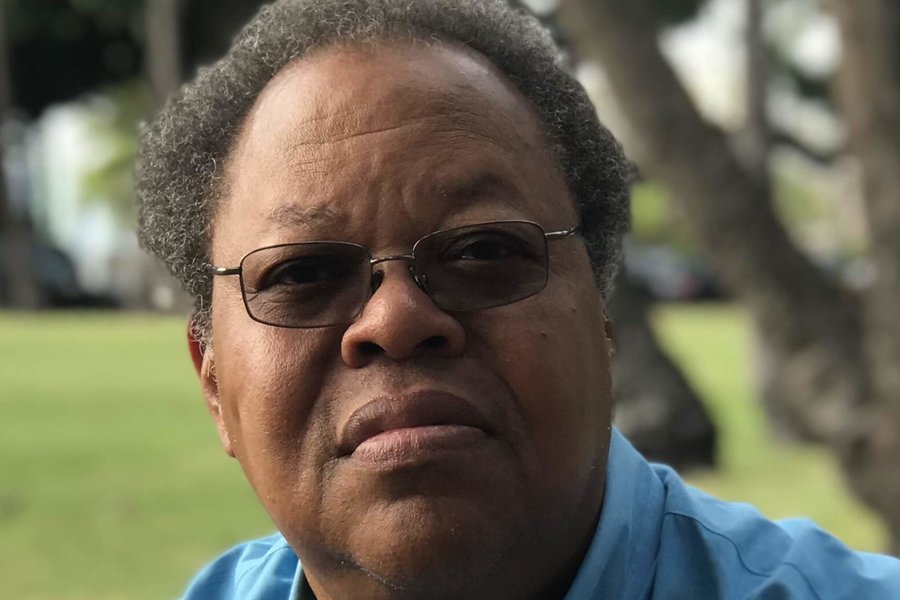
George Lewis
Photograph: Tadashi Lewis
Schick’s part was hardly more virtuosic than those of the ensemble, which were full of jibbering lines and extended techniques. The overall texture was acerbic, but there were moments of unexpected warmth, as when the vibraphone played a beguiling duet with its own recorded echo. In an allusive, non-programmatic way, this music captured the wild joy and creeping delirium that extended physical exertion can bring. The slightly surreal atmosphere was heightened by Nicholas Houfek’s subtle lighting design and the physical separation between ensemble and soloist, conceived by director Jim Findlay: Schick played on the main stage level while the ensemble sat above him in a pillar of light, looking more than a little like they were about to be abducted by a new music–loving UFO.
The work ends with Schick’s arrival in San Francisco to look for wedding rings with his fiancée, an arrival marked by a subtle shift in the music. The surface clouded over with a quiet dread; the resumption of normal life brought security, but at the expense of a freedom as full of life as it is of terror.
When I return home after walking for an extended time, I sometimes feel like a stranger in my own apartment, as though I have transformed myself into a ghost one step at a time. I had a similar feeling in the transition between Soundlines and P. Multitudinis: the electronics played continuously between the two works, and while the acoustic players of the first piece rested in silence, the players for the second set up their chairs and stands, as though the first set of players had simply ceased to exist.
P. Multitudinis gets its name from a posthumous Baruch Spinoza treatise about the relationship between individuals and commonwealths. Lewis took that arcane political theory and turned it into a game: his piece calls for a number of small ensembles (six, in this performance) of fixed and open instrumentation, each of which acts as a semi-autonomous unit as the piece unfolds. Rather than a fixed score, the players are given a set of pre-composed musical fragments (including a distinctive passage of mournful organum) and an array of instructions for how to improvise with and against the prevailing soundscape.
International Contemporary Ensemble members performing ‘P. Multitudinis’ in dress rehearsal at NYU Skirball Center
Photograph: Ian Douglas
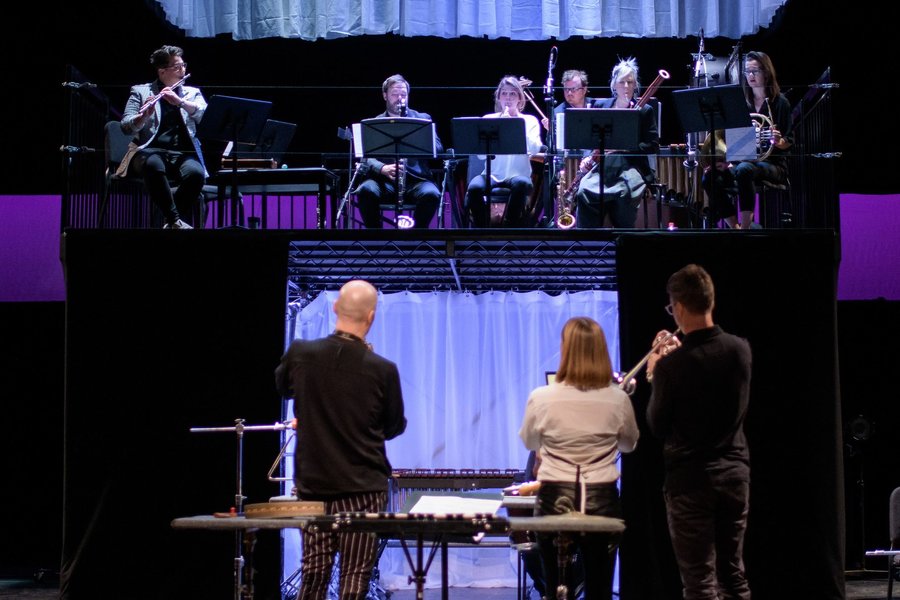
Don’t worry if that sounds technical; if you’ve ever tried to organize something by committee, you’ll recognize the basic principle. One sub-ensemble would present a musical idea; another would pick it up and run with it in another direction. Or two sub-ensembles would team up, participants holding up fingers or forming an X with their forearms to silently negotiate intentions across the auditorium, before jointly entering to change the musical fabric. The lights got in on the action too, changing colors and turning on and off in a mute attempt to join the fray. Vimbayi Kaziboni — who conducted the first piece with precision and warmth — walked leisurely around the space, crouching to whisper suggestions to the various groups.
This is music that has to be experienced live. Even if a recording could capture the spatial elements of the performance — one of the sub-ensembles wandered freely from the stage to the back of the hall, pausing for a while to merge with one of the other sub-ensembles — watching the gestural negotiations take place in real time is half the fun. Indeed, there were several moments where one group’s plans were derailed by the unforeseen entrance of another—as when the leader of the string quartet was about to give a downbeat after a long ensemble back-and-forth, only to jump in surprise as the trombonist in the balcony behind him made a raucous entrance. (The violinist good-naturedly waved for the quartet to stand down and reconsider.)
Just as with more prosaic committees, there were plenty of times when one voice talked over another, and stretches where forward momentum started to lag. And like many a committee meeting, it ended without a firm and tidy resolution. The string quartet traded a few thick chords with one of the mixed ad-hoc ensembles, there was a beat of silence, and then blackout. The music will resume at the next meeting.
Brin Solomon writes words and music in several genres and is doing their best to queer all of them. Solomon majored in composition at Yale University before earning their MFA in Musical Theatre Writing at NYU/Tisch. Their full-length musical Window Full of Moths has been hailed for its “extraordinary songs” that “add magic to otherwise ordinary lives”, and their latest one-act, Have You Tried Not Being A Monster, has been described as “agitprop for Julia Serrano.” Their writing has appeared in VAN, New Classic LA, and National Sawdust Log, and they recently won runner-up at the 2018 Rubin Institute for Music Criticism.
Classical music coverage on National Sawdust Log is supported in part by a grant from the Rubin Institute for Music Criticism, the San Francisco Conservatory of Music, and the Ann and Gordon Getty Foundation. The Log makes all editorial decisions.