On December 15, the legendary soprano Lucy Shelton will present a “tasting menu” of composers with whom she has worked extensively over her decades of performing, including Elliott Carter, Jacob Druckman, Miriam Gideon, Shulamit Ran, and George Rochberg, as well as composers of whose works she provided the first major or complete recordings—songs by John Cage, Ruth Crawford, and Igor Stravinsky.
Now in her 75th year, Shelton is a direct link to many of the most important creative minds of the 20th century. She continues to be a proponent of musical and vocal experimentation through her performances and her extensive teaching and coaching in New York City and throughout the world.
In advance of Shelton’s performance, National Sawdust Log invited Amber Evans – an exciting young Australian soprano, conductor, and composer presently blazing her own trails as an entrepreneurial singer, collaborator, and curator in New York – to talk with Shelton about her career and the program she assembled for her recital, presented as part of a series National Sawdust hosts in collaboration with Open G Records.
NATIONAL SAWDUST LOG: My first question to you is whether you would mind giving Log readers a little bit about you that isn’t so easily found on Google?
LUCY SHELTON: Well, I think I’ve known from a very early age that my life would be in music. It was what gave me the most pleasure. It was a community. I discovered in high school, at music camp, that it was the way I best communicated: not having to find my own words, but being expressive with the music that composers had written down. I played the flute, and it was through playing the flute that I discovered. this. Plus, singing has just always been something I’ve done with my family. I come from a big family. My parents met at an amateur music camp in the ’30s. Music for all of us kids… there were five of us, and we all took piano lessons. we all had an instrument, we did a lot of family music making. So it’s always just been a fun way to be with people. [Laughs]
I’ve always loved the challenge of the newer music—I mean, it was never a separation of, “Oh, golly, now I’m going to do some new music.” It was all just a continuum. And actually, the first professional job I had was early music, with [Chorus] Pro Musica.
So, from first your first professional job being in early music, but new music always being integrated throughout your life, and it being like a gorgeous marriage – between not only the two, but also art song and opera and whatnot – how has that culminated in your National Sawdust program on Dec. 15? What inspired you to curate a program of vocal classics?
I actually asked by Jeremy Gill – who’s the partner, for this series, of Chris Grymes – to bring a program of 20th century rep. I went to my beginnings at Pomona College; there’s a reference to Pomona because Karl Kohn was the composition teacher, and on my senior recital I did songs of his. And he’s the one who introduced me to Stravinsky’s music.
You also have [Elliott] Carter on there, and Ruth Crawford Seeger….
Well, I thought of pieces that I know well. All of this is music I’ve done before, except for the Miriam Gideon selections, which are miniatures – the four songs are less than four minutes long – and the Druckman. And there’s a story behind the Druckman: I studied with Jan DeGaetani and I knew Jacob Druckman, and Jan knew him, and had premiered a lot of things of his. And I got this score, The Sound of Time, a voice and piano piece. A year after its premiere, in 1964, he orchestrated it, and so it was soprano and chamber orchestra, and that was the only version available. But I have the original piano/voice version, which was a Naumberg Foundation commission, and I think it only had the one performance in 1964, at Town Hall. I’m really excited to be doing it. It’s a fabulous piece, texts by Norman Mailer from a book of poetry that evidently wasn’t a big hit, but had some really interesting lines from his published book, Deaths for the Ladies (and other disasters).
I’m actually finding, in preparing this program, that doing pieces I’ve done before is a huge challenge, because I remember how I used to do them, when I’d kind of hear it that way, and my voice is not the same. It doesn’t sound the same, and it’s harder work to find the way to sing them now. Whereas the new pieces, I’m just doing it fresh and meeting the challenges. So it’s actually easier to work on the really difficult Druckman piece than it is to do the little “Pastorale” of Stravinsky—things that are deep-seated in me, but vocally, I’m a different age.
It’s very interesting to think about, because even I will sing pieces that I first sung 10 years ago, and not necessarily like knowing what I used to sound like then, but it’s amazing how muscle memory can just sew itself into your larynx when you come back to a piece. And having to work around that, as opposed to being able to have the advantage and the privilege of looking at something completely new and completely fresh. That’s kind of the beauty of new music, in the sense of there isn’t an integral recording tradition to associate with a lot of pieces. There isn’t necessarily a strict vocal style or idiom. And the individuality of that can be really, really great.
Yes, it’s very freeing to be doing something for the first time. I’ve always thought.
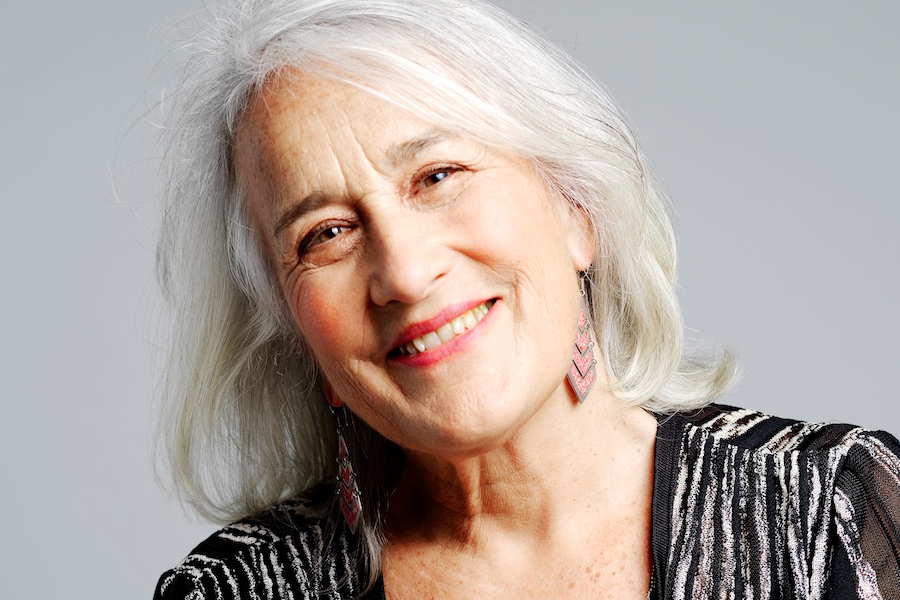
Lucy Shelton
Photograph: Aleksandr Karjaka
Apart from being asked to curate the program, how did you end up assembling the specific order?
It went through so many permutations—and it may still go through some more. I just initially put down a lot of pieces or composers that I think of as pillars, in my recital work, of 20th-century music. And I came up with this menu idea, because I didn’t want to put all the Stravinskys together – they’re tiny little pieces, for the most part. So there’s sort of a Stravinsky idea throughout: I begin with it and I end with it, and it appears in every set, actually.
So I decided to do a tasting menu. There’s only one piece that’s 21st century, and that’s the piece by Shulamit Ran—and I put that in the desserts. I’m doing a tasting menu with appetizers… or amuse-bouche: I decided to go with a French cuisine, even though there’s nothing French on the program.
Of course.
“Pastorale” has no texts, so it’s just a beautiful opening. And then the Cage, “The Wonderful Widow [of Eighteen Springs],” which, as you know, has no real piano part. The pianist plays on the outside of the keyboard, under, above, and on the lid. A very short piece, with James Joyce text. And then, George Rochberg, which also has a lot inside the piano.
So, tasty morsels at the beginning, which are not what anybody would expect a program to begin with. And I’m sort of just stirring the pot.
Definitely a palate cleanser.
Yes, and then, closing the appetizers with one of the Stravinskys, which is a very, very short, dramatic… it’s from the “Four Russian Songs,” but it’s a folk text that doesn’t make any sense, particularly, and has lots of repeated notes in the piano – a very fast, repeated D – and sort of chanting above it. It’s a hoot, it’s really fun.
Then I go to the soups [laughs], and that starts with Stravinsky, one of his very earliest songs. Beautiful, brilliant writing. It’s about the daughter of the bell ringer, who’s very upset to be stuck in the monastery, not being able to go out and meet her lover. Then more Rochberg.
And then the salads: the Carter “Voyage,” which… actually, this is an interesting thing: When I studied with Jan DeGaetani – it was first at Aspen, in ’71, maybe – she gave me the opportunity to sing this Carter piece, “Voyage,” and I sang it in the big tent. I can’t say that I understood the song, but it was the first Carter I’d ever sung, and it’s a really, really beautiful piece that grows on me every time I do it. It’s a very, very beautiful piece, a Hart Crane poem. So I have a long history with that.
Then we have another Stravinsky, “The Owl and the Pussycat,” which is the last piece he wrote. It’s basically just two parts, because the piano is in octaves and then I sing my part, so it’s just two-part counterpoint—and again, just sort of dazzling in its simplicity and expressivity with such minimal means. And then Karl Kohn—the songs I’m doing are from a set that he actually dedicated to me, from 1985. The first one is “A Pig” and the second one is “Leisure.” They’re funny texts. And I wanted to put it next to Stravinsky, because he’s the one who brought Stravinsky to my attention.
And then, the entrees… I mean, I’m going to be really full already, and maybe the audience will be, too! [Laughs] Now we’re getting to the protein. The Druckman, “The Sound of Time,” is the first of the entrees, and it’s the longest piece on the program—it’s 12 minutes. As I said, I think this is only its second performance in this version, and it’s astounding. It’s really, really beautiful. That’s all I have to say about that.
People will have to hear it.
They will have to hear it. And then, pieces that are very rarely done by Ruth Crawford – if you want to add Seeger, that might make her more recognizable – from 1932, the “Two Ricercari.” These are political poems by a Chinese immigrant, Tsiang, that first appeared in a newspaper. Ruth Crawford saw them and set these two, “Sacco, Vanzetti,” and “Chinaman, Laundryman.” They’re very powerful diatribes. The texts are very challenging to the listener, and the piano writing is extremely hard in both of them—by the way, I’m using four different pianists throughout this program, which came about because certain of the repertoire I’d already done with pianists, so I wanted them to repeat it. It also means that I get to rehearse a whole lot and don’t wear anybody out, because I have four different people to work with.
These Crawford pieces are also very challenging vocally… “Sacco, Vanzetti” is written in almost sprechstimme; she says right at the top: don’t worry about the pitches, make sure that the text is heard. So I’m kind of doing a sprechstimme – I don’t think I use vibrato at all in it – just to help get the language across. It’s like a soapbox oration, both of them.
And then we get to dessert and the little Miriam Gideon pieces, which are beautiful two-line poems from ancient Japanese tanka. And then the Shulamit Ran, which is a setting of “The Song of Songs,” which is very sensuous, and a piece that I’d done last June. I actually was part of its commission; it was for Songfest, and so I saw it through its premiere with a student in 2016, and then I first sang it just last June. Then a tiny, little Stravinsky lullaby—which I am going to sing in French.
We’ll just flip over the amuse-bouche and have it for dessert, instead.
Yeah, and then ending with the some raucous little children’s songs by Stravinsky—again, three of them, which barely take three minutes. So it looks like a long program, but it’s actually not. And at some point I thought I might just list these, have a prix fixe, and sort of make up three different meals. You know, make a five-course meal, do it three times, and cover the repertoire that way. But I got a little dizzy, and thought that the audience might get a little confused about what was happening. I still may pick and choose. It’s going to be informal.
A banquet should be informal, especially if it’s a tasting menu.
It’s a tasting menu.
People will need a week to digest after.
That’s probably true!
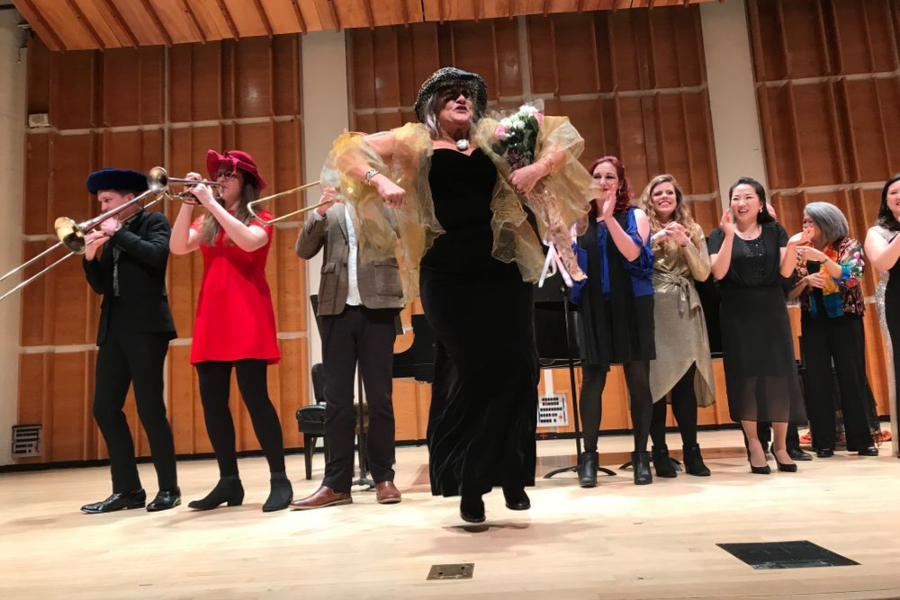
Lucy Shelton (center) performing at Merkin Hall, Feb. 24, 2019
Photograph: lucyshelton.com
The Druckman that you mentioned this being its probably definitely second performance… in how many years?
It was ’64, so 55 years.
When we’re thinking about music being written today, and some might argue that there’s a lack of visibility and support for today’s artists, there’s a very capitalist nature of “everything needs to be a world premiere.” What do you think about the way that the canon’s been been shaped, when a piece like the Druckman hasn’t been a part of the repertoire…
Well, that may have been Jacob’s choice. The piano part is so hard that I think he was thinking of orchestrating it even when he first wrote it down, because there are notes for orchestration in his manuscript—not in the part that I have, but the one that’s at the library.
I mean, it’s always a problem: premieres, yes, that gets some attention, but a piece doesn’t really satisfy the performers or the composer, I think, until it’s lived a little longer and had more than one performance. It’s crazy to keep taking new mouthfuls of repertoire. [laughs] If we’re involved in new music, I think we all need to champion pieces, find second, third, fourth performances, and do things more than once, because they only really solidify after a few performances.
When looking back at the trajectory of your career, and your contribution to the contemporary-classical vocal world in particular, how do you perceive how the canon has been shaped and changed, in terms of how your career has progressed, and continues to?
It’s always been true that opera is the only career people think of when they go into this. People don’t think they can make a career without opera; well, I actually have. I’m going to be making my operatic debut in 2020 with a new opera. In college I did Gilbert and Sullivan. I’ve done some concert opera—a concert Fidelio, I’ve done the Dallapiccola Il prigioniero in concert. But the whole rhythm of being in opera didn’t particularly appeal to me, because of my appetite: I like lots of projects. I wouldn’t have been happy being in a place for two months and doing just one piece—which is what I’m going to experience, soon. [Laughs]
For young students heading into a vocal career, I just hope they include doing recitals and chamber music, because those are the areas where you can make your own challenges and develop things on your own, not just waiting to be asked, doing the auditions, and being chosen out of the thousands. Auditions are about as far from a true musical presentation… because it’s so wrapped up in the competition, and making an impression. Singers need to be presenting very personal, heartfelt, committed performances, renderings of the music. The whole audition thing seems so tipped to sensationalism instead of really heartfelt communication.
So from what you’re saying, that is what has been the main stage for you, in how it has shaped your career into a trajectory of really being true and authentic to yourself, and having that heartfelt connection with not just a project that you’re committed to, but with as many as your soul wants to outpour for.
Yeah… I think that sounds nice. And Jan DeGaetani was the model for that. She was so committed in every performance. She had such direct connection. It was so honest, and that was a great model for me to have—for anybody to have. I hope that I’ve carried that out in my own career.
I mean, you do do jobs that maybe aren’t the things that you most want to do, but, but they pay you and it’s a professional thing, and you do it—and you always can say no. And that’s probably one of the hardest things to learn: to allow yourself to say no, and know that you’re not jeopardizing other opportunities. It’s a tricky road to go down, and it’s trickier now than when I started out. I really got my performance legs through doing chamber music with the Jubal Trio, after I came to New York. That was flute, harp, and soprano, and for about seven years we were doing 50, 60 concerts a year, commissioning people and doing lots of new pieces. It was beautiful. It was great.
It sounds like a dream.
It was a dream. It was.
Speaking of long-term commitment to pieces, I see that at the 92nd Street Y in January you’re going to be doing Pierrot Lunaire, and it’s part of a series exploring the boundaries of speech and song. I don’t think, in terms of the 20th-century canon, that there could be anything that holds a candle to what that piece by Schoenberg does in terms of not just exploring those boundaries, but absolutely shattering them—and we’re still picking up the pieces today.
Yeah, Pierrot is a piece that I first learned in the late ’70s, and I hope to be doing it… well, I’m in my seventies now [laughs] and I hope to be enjoying it for a few more decades. The sprechstimme style of writing is still a mystery; it’s undefined enough that everybody who does it has to find their own way to do it—something between singing and talking. There are only nine pitches in the 21 movements that are marked to be sung, so those would have vibrato and you’d stay on the pitch. Otherwise, you’re doing something other, that has pitch range. The text is paramount. You still have rhythm and dynamics and articulations, everything that music normally has, but you don’t sustain the pitches.
There are many, many ways to approach it, and I’ve actually never learned the pitches separately, because I think it’s very hard to go from singing the pitches to releasing them into the sprech. And the 92nd Street Y is with a band of top-notch New York players, and it’s paired with the Janáček [Diary of One Who Disappeared], with Jennifer Johnson Cano.
I’ll never get tired of doing Pierrot, because it’s never the same… actually, that’s true for any piece, but the parameters are wider in how you do it. I’ve probably been pretty consistent in how I do it—but the notion that I don’t have to be, that’s very freeing.
Lucy Shelton presents a recital at National Sawdust on Dec. 15 at 7pm; nationalsawdust.org. She performs Pierrot Lunaire at the 92nd Street Y on Jan. 24 at 8pm; 92y.org.
Amber Evans is a vocalist, conductor, and composer originally from Brisbane, Australia, currently based in New York. She regularly performs as an early-music soloist, chorister and contemporary chamber musician throughout the U.S. and internationally. Winner of the inaugural US Dwight and Ursula Mamlok Advancement Award for the interpretation of contemporary music, she is committed to the vital artistic collaboration with composers to contribute to the musical canon of the present day.